Starting a business in Greater China? One of the most critical decisions you’ll face is picking between a mainland China firm and a Hong Kong limited company. Both structures can support your commercial goals, yet they operate under entirely distinct regulatory frameworks, tax rules and operational models.
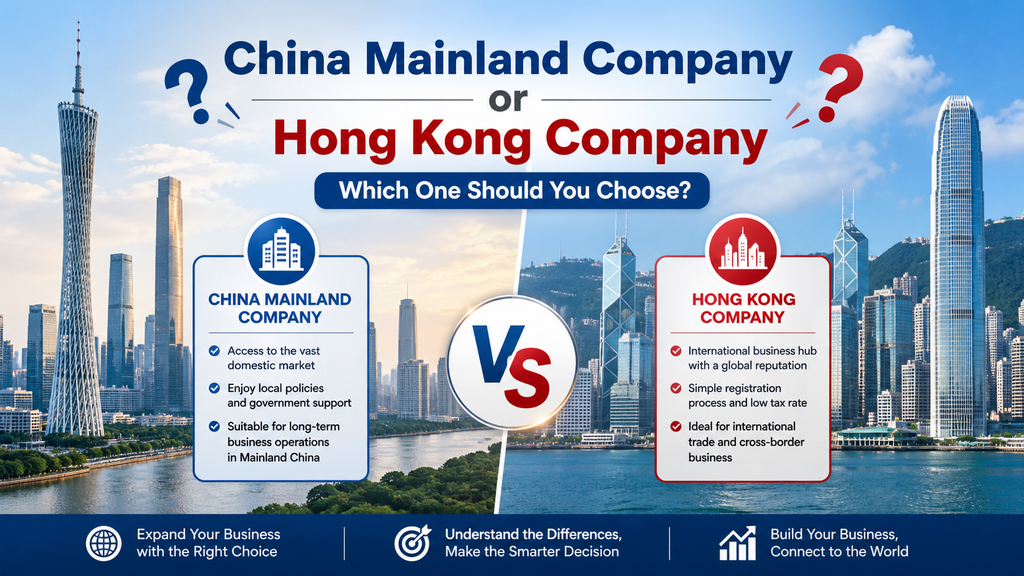
This guide breaks down core differences covering registration requirements, taxation schemes, recurring running costs, and unique competitive edges of each entity. By the end, you can pick the corporate structure perfectly aligned with your long-term business expansion plans 📊
Ⅰ. Registration Requirements Comparison 📝
Shared Requirements for Both Entities
Whether you register in Hong Kong or mainland China, you need to prepare the identical basic documents:
- Passports of all company founders
- Confirmed director and shareholder details, plus equity allocation ratios
- Defined business scopes
- Agreed registered capital amount
- Personal residential address, contact phone number and business email of applicants
Key Differences in Registration Rules
| Mainland China Company | Hong Kong Company |
| Must provide a physical, rented office address for registration | Allows using a professional secretary service address as the registered address |
| A mainland Chinese mobile phone number is mandatory for official filings | No requirement for a local Hong Kong phone number |
| Registered capital must be fully paid within 5 years | Zero mandatory paid-in capital requirement; no capital contribution timeline |
| Appoint a Chinese liaison officer as a compulsory filing role | No liaison officer position required by law |
| No need for passport photos held by directors/shareholders | Directors and shareholders must submit photos holding their passports |
| No residential proof submission for stakeholders | All directors and shareholders need to provide official residential address proof |
Ⅱ. Taxation Framework Overview 💰
Tax rules form the biggest divide between Hong Kong and mainland businesses. We compare the two sides across tax brackets, filing deadlines, dividend taxation, tax jurisdiction principles and annual reporting cycles:
- Mainland China enterprises follow territorial plus worldwide taxation standards, with monthly VAT filings, quarterly corporate income tax declarations and mandatory annual tax settlement in June. Multiple tax categories apply, raising regular compliance workload.
- Hong Kong adopts the territorial source taxation principle: only profits generated from business activities within Hong Kong are taxable. There are no monthly tax filings; companies only complete one annual tax return alongside audit reports, drastically cutting repetitive tax work.
- Dividend policies also differ greatly: mainland firms face extra withholding tax when distributing profits overseas, while Hong Kong enjoys tax exemptions or reduced tax rates on cross-border dividends under many double taxation agreements.
Ⅲ. Recurring Operational & Compliance Costs 🧾
Running Costs of a Mainland China Company
- Monthly mandatory individual income tax declarations for staff
- Quarterly corporate income tax and VAT filings
- Fixed monthly expenditure on physical office rental
- Annual industrial and commercial inspection, plus year-end corporate tax reconciliation every June
These recurring monthly and quarterly fees create stable, continuous financial pressure for small and medium-sized traders.
Running Costs of a Hong Kong Company
There are only two major yearly fixed expenses:
- Annual business registration renewal fee to extend the company’s legal status
- Annual statutory audit report preparation fee for tax submission
Without monthly or quarterly recurring compliance charges, Hong Kong entities boast much lower regular administrative overheads.
Ⅳ. Unique Advantages of Each Corporate Structure ✨
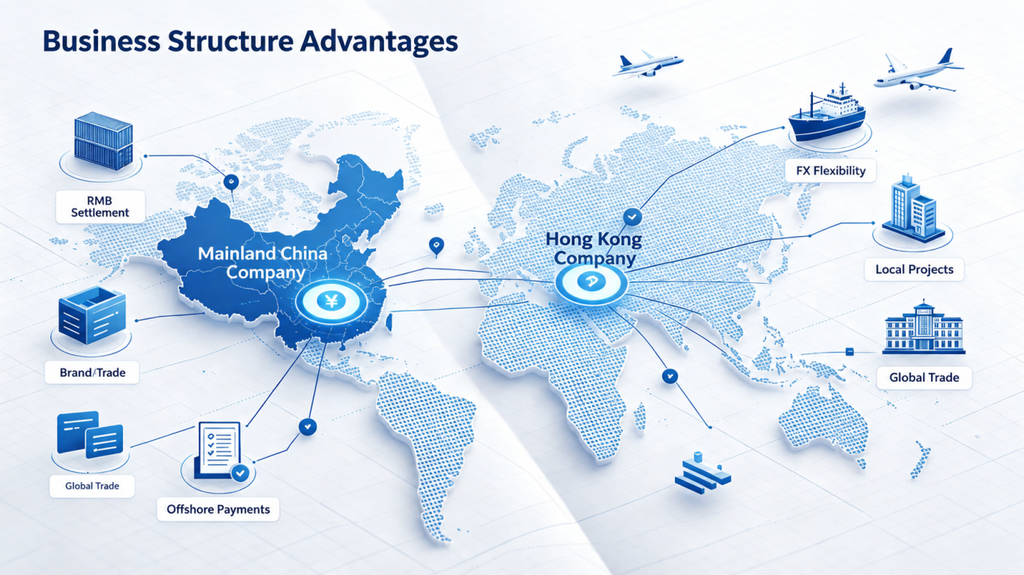
Core Strengths of a Mainland China Company
- Eligibility to apply for Chinese work visas for foreign staff, convenient for onshore team management
- Direct RMB collection and settlement capabilities, supporting domestic wholesale, retail and local project cooperation
- Full access to domestic government subsidies, industrial policy incentives and local bidding projects
- Credible domestic brand recognition for customers and partners based in mainland China
Core Strengths of a Hong Kong Company
- Fully liberal foreign exchange system with no capital control: freely convert, receive and transfer global currencies
- Ideal structure for cross-border import & export, overseas brand building and global market expansion
- Access to international banking channels, facilitating offshore supplier and buyer payment settlements
- Simple annual compliance procedures with minimal administrative burden for international traders
Ⅴ. A suitable choice
Suitable for registering a company in mainland China:
- The core market is primarily located in mainland China.
- You are a foreign client requiring a Chinese work visa.
- Your operations involve hiring a team in mainland China and handling routine settlements in RMB.
Suitable for registering a Hong Kong company:
- The company focuses on global cross-border trade and overseas business expansion.
- The company has an ongoing need for cross-border settlement services.
- The company needs to establish an overseas corporate structure to align with international standards in the future.
Final Thoughts 🎯
Neither a mainland China company nor a Hong Kong company is universally superior. Align your corporate registration choice with your short-term operations and long-term development blueprint, and your business will gain solid institutional support to thrive in global markets.
Our goal is to help you understand the differences between the two locations regarding business advantages, tax and legal requirements, market access, the investment environment, and operating costs. This is precisely KERUI’s mission.
The content of this article is for reference only and does not constitute legal or tax advice. Requirements may vary depending on specific circumstances; please consult a licensed or qualified professional before registering a company.